
Starke County Criminal Court Records
A criminal court record is the court-maintained case file opened when the State of Indiana files charges against a defendant. In Starke County, criminal felonies and misdemeanors are part of Starke Circuit Court's jurisdiction. The record can include the charging information, probable-cause material when public, arrest warrant or summons events, initial hearing, bond order, attorney appearances, plea entries, motions, pretrial conferences, trial settings, judgment, sentence, probation terms, restitution, fines, costs, and final orders.
Starke Circuit Court is the local trial court for criminal cases, while Knox City Court handles traffic tickets and city-court matters. If a Knox City Court matter is appealed, the Starke Circuit Court may later show appeal activity. For a narrower look at the arrest-to-charge path, use the Starke County arrest records and court charges page. The full criminal court record remains the place to read the outcome, sentence, and post-judgment activity.
Search Starke County Criminal Court Records
Use Indiana MyCase to search public Starke County criminal court records by name or case number. The Starke Circuit Court site links case search to MyCase, and Indiana Judiciary says public users may search non-confidential case information and many public documents. Some criminal final orders and judgments may be linked online, but a missing document link does not prove the document is closed. It may only mean the Clerk must provide the copy.
- Open MyCase and choose a public search option.
- Enter the defendant name or full case number.
- Filter to Starke County and review the court and case type.
- Open the criminal case and read charges, docket entries, hearings, plea, disposition, and sentence fields.
- Contact the Starke County Clerk for certified copies or official financial balances.
Criminal-history and background-check needs are not the same as a court case lookup. MyCase shows court case information, not a full law-enforcement background report. Indiana expungement and juvenile access rules can also limit what a casual public search shows.
The screenshot source for Indiana criminal-law context is Indiana Code Title 35.
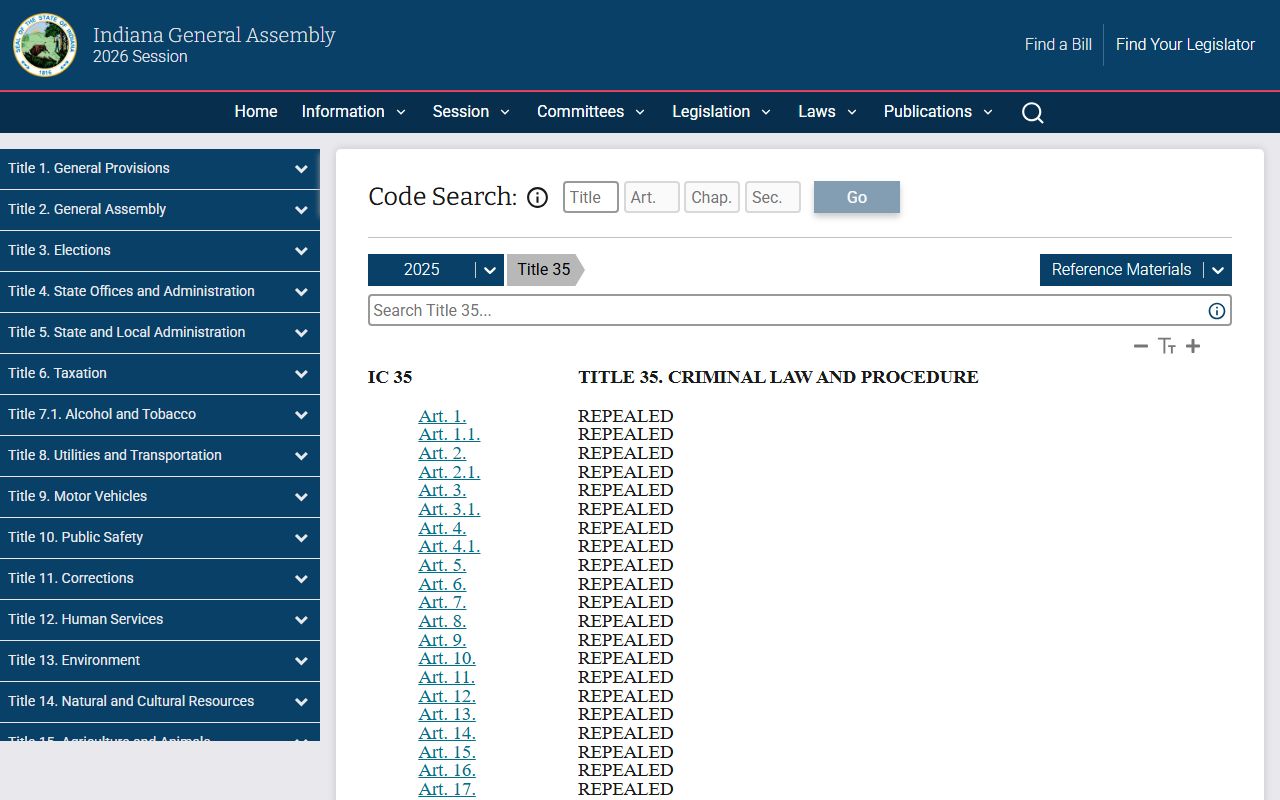
Title 35 is relevant because Indiana criminal procedure and expungement rules shape Starke County criminal court records.
Starke Criminal Case Stages
Criminal case stages appear as docket entries and documents. The prosecutor files the charge. The court holds early hearings for rights, counsel, bond, and scheduling. Motions may ask the court to suppress evidence, continue a hearing, change bond, or decide a legal issue. A case can end by dismissal, plea, bench trial, jury trial, acquittal, conviction, or another disposition. If there is a conviction, sentencing and probation entries become central parts of the record.
Case flow: Charges Filed › Arraignment › Pretrial / Motions › Plea or Trial › Disposition › Sentencing
| Stage | What Happens |
|---|---|
| Charges filed | The Prosecuting Attorney files the formal accusation in court. |
| Initial hearing / arraignment | The court addresses rights, the charge, counsel, bond, and next settings. |
| Pretrial / motions | Parties file requests, exchange required information, and prepare for plea or trial. |
| Plea or trial | The case resolves by plea agreement, bench trial, jury trial, dismissal, or acquittal. |
| Disposition | The docket shows the outcome for each count or the case as a whole. |
| Sentencing | The court enters punishment, probation, costs, restitution, jail credit, or other terms after conviction. |
What Starke Criminal Records Show
Starke County criminal court records should be checked count by count. One arrest can lead to several counts, and each count can end differently. A dismissed charge is not a conviction. A reduced charge may have a different severity level than the original. Probation terms, home detention, treatment requirements, random drug screens, and employment conditions may also appear because Starke County has a documented local history of pretrial reform and court-based treatment options.
| Field | What It Shows |
|---|---|
| Case number | The Indiana court case identifier used for searches and copy requests. |
| Defendant | The person charged, with identifiers limited by public-access rules. |
| Prosecutor | The State of Indiana's attorney, locally tied to the Starke County Prosecuting Attorney. |
| Charges | Offense description, statute, severity, count number, filing date, and status when public. |
| Hearings | Initial hearings, pretrials, bond hearings, trial settings, sentencing, and review hearings. |
| Plea | Guilty, not guilty, or other plea activity shown in the docket. |
| Disposition | Convicted, dismissed, acquitted, amended, reduced, or other outcome by count. |
| Sentence | Jail, probation, home detention, treatment, fines, costs, restitution, or other court terms. |
Charges vs Convictions
Starke County criminal court records can show charges that never became convictions. A charge is an accusation filed by the prosecutor. A conviction follows a guilty plea, guilty verdict, or other adjudication that results in guilt. The docket may also show a charge that was amended, reduced, dismissed, or resolved by acquittal. Read the disposition field before treating any criminal charge as an outcome.
| Charge | Conviction | |
|---|---|---|
| Meaning | An accusation filed in court. | A legal finding or plea of guilt. |
| Record stage | Appears when the case starts or is amended. | Appears after plea, verdict, or judgment. |
| Can change | May be amended, reduced, or dismissed. | May be appealed, modified, or later expunged if eligible. |
| How to verify | Review charge rows and docket entries. | Review disposition and sentencing entries. |
Note: A Starke County charge row is not the same as a conviction unless the disposition shows guilt.
Starke County Criminal Supervision
Starke County's criminal records can reflect local supervision practices. Judge Kim Hall's official court materials say the county began serving in 2017 as an Indiana pilot program for Evidence-Based Decision Making and Pretrial Reform. The court describes using home detention with GPS monitoring, substance-abuse counseling, random drug screens, and employment-seeking requirements in appropriate cases instead of relying only on money bond. Those terms may show up in bond, pretrial, sentence, probation, or compliance entries.
The Starke Circuit Court Recovery Program began in 2022 and uses grant-funded in-house treatment services for qualified people as a term of probation. Starke County also has a Regional Therapeutic Community Drug Treatment program tied to the Justice Center and Indiana Department of Correction placement recommendations. These programs do not replace the criminal court record. They explain why a Starke County case may include treatment, supervision, home detention, or community corrections entries.
The screenshot source for local criminal supervision context is the Starke County Probation page.
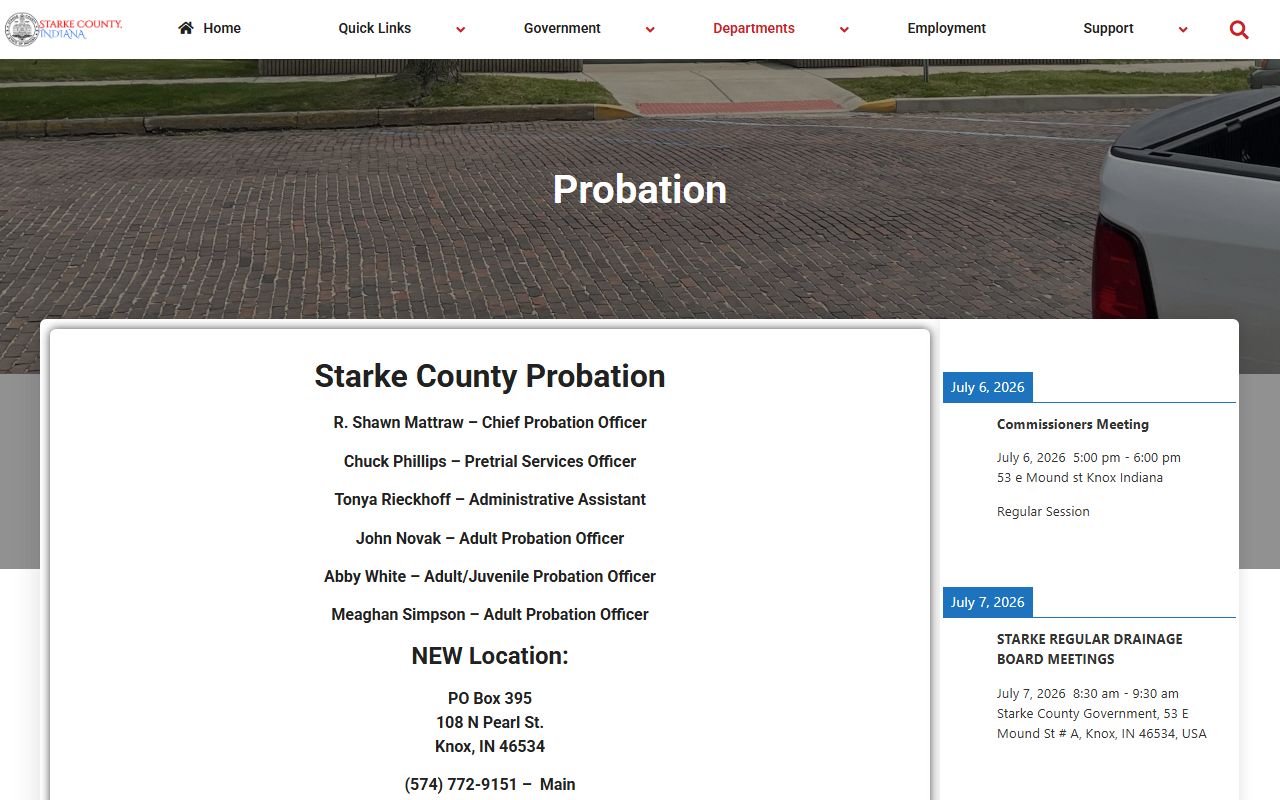
Probation details help explain many post-disposition entries in Starke County criminal court records.
The screenshot source for probation compliance context is the Starke County Probation FAQ.
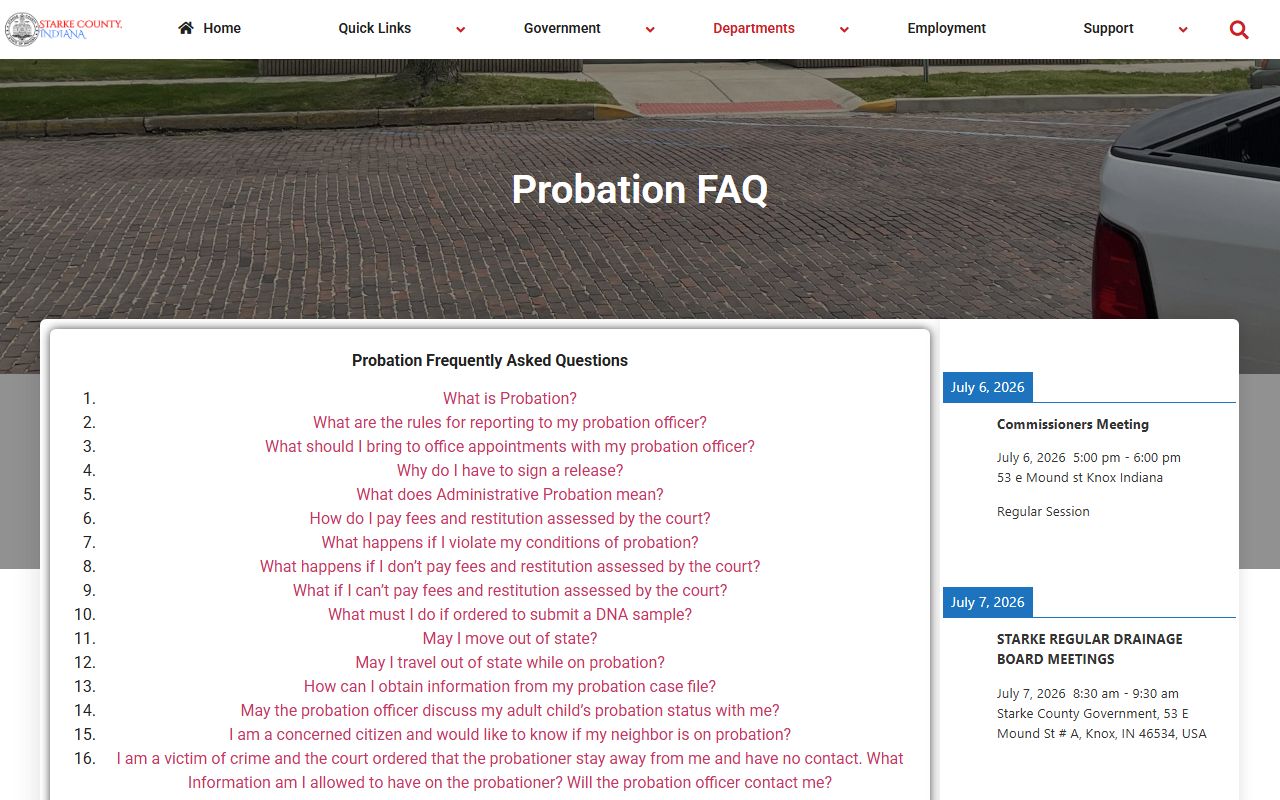
That FAQ context supports record entries about reporting, address changes, employment, and compliance after sentencing.
Sealed vs Expunged Records
Indiana expungement law is in IC 35-38-9. It has different rules for arrests that did not lead to conviction, misdemeanors, Level 6 or Class D felonies, more serious felonies, and matters that require prosecutor consent or court discretion. A person seeking to restrict a Starke County criminal record should identify every case number, confirm the official disposition with the Clerk, file in the court that handled the case, and serve required parties such as the prosecutor when the law requires it.
| Sealed | Expunged | |
|---|---|---|
| Public view | Excluded or hidden from general public access. | Restricted, sealed, or marked under Indiana expungement rules depending on the order. |
| Where it happens | By court rule, statute, or court order. | By petition and order under Indiana expungement law. |
| Examples | Juvenile, mental health, protected data, confidential filings. | Qualifying arrest, charge, or conviction records. |
| Follow-up | Use Rule 9 if seeking access to excluded court records. | Check MyCase and Clerk records after an order is granted. |
Public Access to Starke Criminal Records
Criminal case files are generally public unless an Indiana statute, federal law, or Indiana court access rule restricts the record. The Indiana Access to Court Records Rule 5 lists excluded records, and Rule 9 gives a process to seek access to excluded records. Juvenile matters, sealed or expunged records, protected-order identifying information, adoption records, and mental-health records are common limits.
Important: Court case searches are not FCRA consumer reports and should not be used for regulated screening decisions.
The screenshot source for the local prosecutor context is the Starke County Prosecutor page.
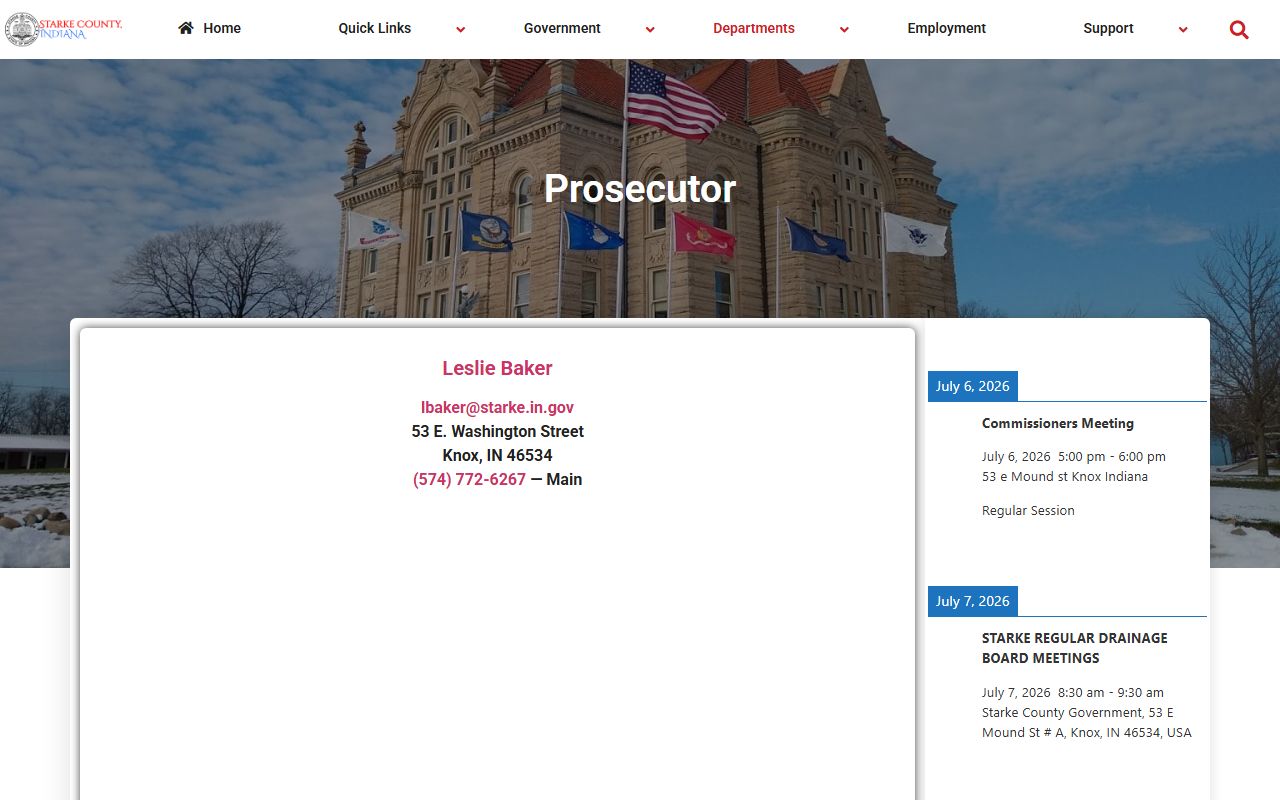
Prosecutor Leslie Baker's office is relevant because the prosecutor decides which criminal charges are filed in court.